 orywire
News that matters globallyReporting on public life and major developments across the U.S., the UK, and beyond.
orywireThe May 2026 CPI report showed consumer prices rose 0.5% for the month and 4.2% from a year earlier. Core CPI increased 0.2% in May and 2.9% over 12 months, while energy prices accounted for most of the monthly increase.
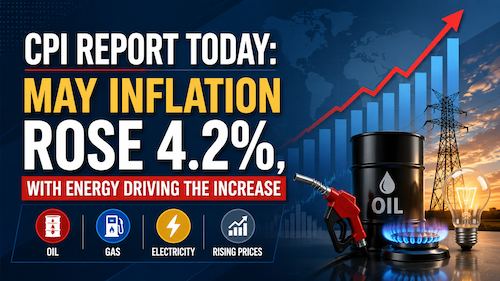
The CPI report today showed U.S. consumer prices rose 0.5% in May and 4.2% from a year earlier, according to the Bureau of Labor Statistics. Core CPI, which excludes food and energy, increased 0.2% for the month and 2.9% over the past 12 months.
Energy was the biggest reason the headline number stayed elevated. The BLS said energy accounted for more than 60% of the monthly increase in the all-items index.
Monthly CPI figures below are seasonally adjusted. The 12-month figures are before seasonal adjustment, unless noted by BLS.
The 4.2% annual inflation rate was higher than April’s 3.8% reading. The monthly increase, however, eased slightly from April, when CPI rose 0.6%.
The headline number moved in two directions at once: annual inflation accelerated, but the monthly pace cooled slightly.
The all-items index rose 4.2% for the 12 months ending in May, up from 3.8% for the 12 months ending in April. On a monthly basis, CPI rose 0.5% in May after increasing 0.6% in April.
Core inflation also showed a mixed picture. Core CPI rose 0.2% in May after a 0.4% increase in April, but the 12-month core rate ticked up to 2.9% from 2.8%.
That makes the May report a headline-inflation story more than a broad acceleration across every major category. Energy prices did most of the lifting, while several core goods and services categories moved more slowly or declined.
Energy prices rose 3.9% in May after increasing 3.8% in April and 10.9% in March, the BLS said.
Gasoline had the largest effect inside the energy category. The gasoline index rose 7.0% in May on a seasonally adjusted basis. Before seasonal adjustment, gasoline prices increased 8.6% for the month.
Over the past year, energy prices rose 23.5%. Gasoline was up 40.5% from a year earlier, while electricity rose 5.9% and natural gas rose 3.0%.
The monthly energy details were not all the same. Electricity rose 0.6% in May, while natural gas fell 0.5%.
Food prices rose 0.2% in May, slower than the 0.5% increase reported in April.
Grocery prices, measured as food at home, rose 0.1% for the month. Food away from home increased 0.3%, with both limited-service meals and full-service meals rising 0.3%.
Over 12 months, food prices were up 3.1%. Food at home rose 2.7%, while food away from home rose 3.5%.
Shelter, the largest category for many households, rose 0.3% in May. Owners’ equivalent rent increased 0.3%, rent rose 0.4%, and lodging away from home also rose 0.4%.
The shelter index was up 3.4% from a year earlier.
Core CPI rose 0.2% in May after rising 0.4% in April. Inside core inflation, several service categories still increased, but some goods and insurance categories fell.
The communication index rose 1.3% for the month. Airline fares rose 2.7%, personal care increased 1.0%, and recreation and apparel each rose 0.3%. Used cars and trucks edged up 0.1%.
Medical care rose 0.3% in May. Hospital services increased 0.7%, while prescription drugs fell 0.9% and physicians’ services were unchanged.
Several categories moved lower. Motor vehicle insurance declined 1.7%, household furnishings and operations fell 0.6%, and new vehicles fell 0.3%.
For readers comparing the report with expectations, Reuters reported that economists it polled had forecast CPI to rise 4.2% from a year earlier and 0.5% for the month, matching the headline BLS release.
The CPI is a national average, not a personal budget. Individual households may feel the report differently depending on how much they spend on gasoline, electricity, rent, groceries, medical care, travel or insurance.
For May, the clearest takeaway is that energy pushed headline inflation higher, while core inflation cooled on a monthly basis. Food and shelter still rose, but neither increased as sharply as energy.
The report also matters because CPI is one of the main gauges used to track inflation across the U.S. economy. BLS says CPI measures price changes for goods and services bought by urban consumers, a group that represents more than 90% of the U.S. population.
The next CPI release will cover June 2026. BLS has scheduled that report for Tuesday, July 14, 2026, at 8:30 a.m. ET.
The May numbers are the latest official CPI figures available from BLS as of the last check.