 orywire
News that matters globallyReporting on public life and major developments across the U.S., the UK, and beyond.
orywireThe CDC says 2,030 confirmed measles cases have been reported in the United States in 2026, with most cases tied to outbreaks. The latest update also explains why state counts may differ from the national total.
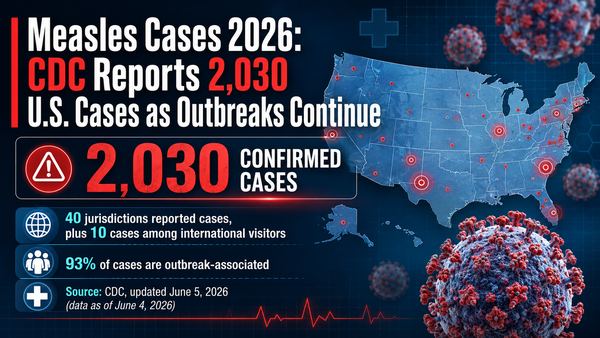
The CDC has reported 2,030 confirmed measles cases in the United States in 2026, with most cases linked to outbreaks. Readers checking their own risk should use the CDC for the national count and their state or local health department for exposure notices and faster local updates.
The CDC’s latest national measles page was updated June 5 and lists 2,030 confirmed cases as of June 4, 2026.
Of those cases, 2,020 were reported by 40 U.S. jurisdictions. The CDC also reported 10 cases among international visitors to the United States.
The jurisdictions listed by CDC were: Alaska, Arizona, California, Colorado, District of Columbia, Florida, Georgia, Idaho, Illinois, Kansas, Kentucky, Louisiana, Maine, Maryland, Massachusetts, Michigan, Minnesota, Missouri, Montana, Nebraska, New Jersey, New Mexico, New York City, New York State, North Carolina, North Dakota, Ohio, Oklahoma, Oregon, Pennsylvania, Rhode Island, South Carolina, South Dakota, Texas, Utah, Vermont, Virginia, Washington, Wisconsin and Wyoming.
CDC says the national page includes only confirmed measles cases that jurisdictions have notified to the agency. Probable cases reported by states are not included in the CDC total until they are confirmed and reported to CDC.
CDC reported 30 new measles outbreaks in 2026. The agency defines an outbreak as three or more related cases.
Most of the confirmed cases this year are outbreak-associated. CDC said 1,890 of the 2,030 confirmed cases, or 93%, were tied to outbreaks. That includes 558 cases from outbreaks that began in 2026 and 1,332 cases from outbreaks that started in 2025.
For comparison, CDC reported 2,288 confirmed measles cases for all of 2025, with 48 outbreaks that year. The 2026 count is not a full-year comparison, but it is already close to the 2025 annual total.
State and local health departments often publish measles updates on different schedules from CDC. That means a state dashboard may show newer local information before it appears in the national count.
CDC says states have the most up-to-date information about cases and outbreaks in their jurisdictions. Its national page reflects confirmed cases reported to CDC as of the weekly reporting cutoff.
Utah is one example of why local pages matter. Utah’s Department of Health and Human Services, one of the state sources linked from CDC’s national page, reported 478 Utah residents diagnosed with measles in 2026 and nine residents reported to public health in the previous three weeks as of its June 2 update.
Measles symptoms usually begin 7 to 14 days after infection, according to CDC. Early symptoms typically include high fever, cough, runny nose and red, watery eyes. A rash usually appears three to five days after the first symptoms.
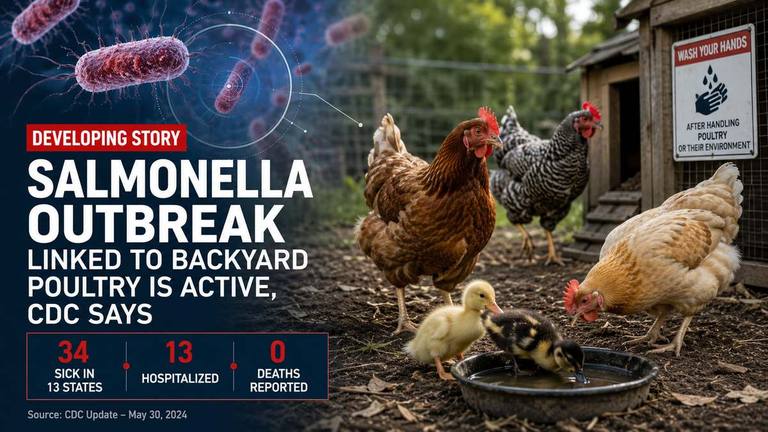
CDC says multistate Salmonella outbreaks linked to backyard poultry remain open, with 513 reported illnesses, 134 hospitalizations and one death. Families and flock owners are urged to wash hands, keep birds outside the home and keep young children away from chicks and ducklings.
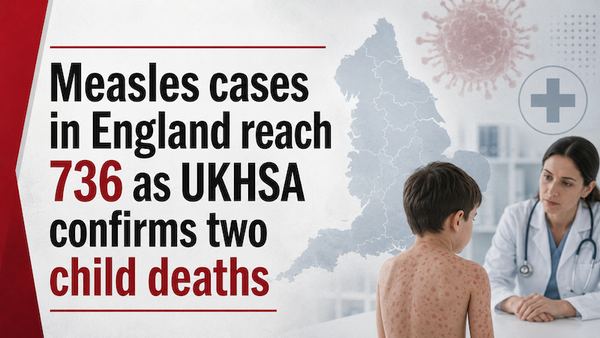
UKHSA says England has recorded 736 laboratory-confirmed measles cases so far in 2026, with two child deaths confirmed. The latest figures show recent activity has been highest in London, the East of England and the West Midlands.
CDC says people should call a healthcare provider immediately if they think they or their child have been exposed to measles. Anyone with possible measles symptoms should call before going to a clinic or hospital so staff can help prevent other patients from being exposed.
Local health departments may also post exposure locations, dates and symptom-watch instructions. Utah health officials said measles virus can remain in the air for up to two hours after a person with measles has been in a location.
CDC says the best protection against measles is the measles, mumps and rubella vaccine, known as MMR. Two doses are 97% effective at preventing measles, while one dose is 93% effective, according to CDC.
People who are unsure of their vaccination status, planning international travel or living in an area with an outbreak should talk with a healthcare provider or local health department. During outbreaks, public health authorities may recommend vaccination steps for people at increased risk.
CDC’s national measles count is updated on a regular schedule, but state health departments may update local case counts and exposure sites more frequently.
The most important figures to watch next are the national confirmed case count, the number of outbreak-associated cases and any local exposure notices from state or county health departments.
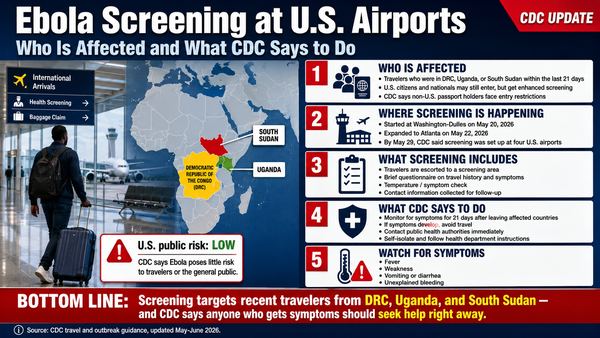
CDC says certain travelers who were recently in the Democratic Republic of the Congo, Uganda or South Sudan may be routed to four U.S. airports for enhanced Ebola screening. The agency says the U.S. risk remains low, but affected travelers should monitor symptoms for 21 days after leaving those countries.