 orywire
News that matters globallyReporting on public life and major developments across the U.S., the UK, and beyond.
orywireNHS England says eligible men with early, low or intermediate-risk prostate cancer will be offered SABR radiotherapy, a more targeted treatment usually given in five doses. Patients should ask their specialist team whether it is suitable for their diagnosis and treatment plan.
 By
By 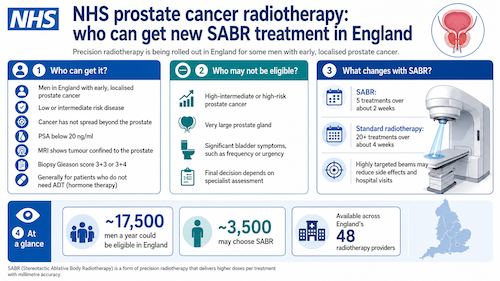
Eligible men in England with early prostate cancer are to be offered SABR radiotherapy on the NHS, cutting treatment from at least 20 standard radiotherapy doses to five in many cases. Patients already discussing treatment for low or intermediate-risk localised prostate cancer should ask their specialist team whether the new option is suitable for them.
NHS England has announced a rollout of stereotactic ablative radiotherapy, known as SABR, for eligible men with early prostate cancer.
The treatment delivers radiotherapy to the tumour from multiple directions, using a more concentrated and precise dose than standard external beam radiotherapy. NHS England says this can help limit damage to healthy tissue and reduce the number of hospital visits needed.
SABR is typically delivered in five doses within a fortnight. Standard external beam radiotherapy for prostate cancer usually requires at least 20 doses, meaning the new approach could spare some patients 15 hospital treatment sessions.
The first centres are expected to make the treatment available from next week. NHS England says SABR for localised prostate cancer is expected to be offered at all 48 radiotherapy providers across England.
NHS England says around 17,500 men are diagnosed each year in England with low or intermediate-risk prostate cancer and could be offered the option of SABR.
That does not mean everyone in that group will automatically receive it. NHS modelling suggests around 3,500 men, nearly a fifth of those with this form of cancer, may choose to take up the treatment.
Suitability will depend on clinical assessment, including the type and stage of cancer, previous treatment, existing symptoms and whether radiotherapy is the right option at all. Professor Peter Johnson, NHS national clinical director for cancer, said SABR is not suitable for everyone with localised prostate cancer and encouraged patients with questions to speak to their specialist team.
SABR is a type of external radiotherapy. It uses focused beams from several angles so that a higher dose meets at the tumour while surrounding healthy tissue receives a lower dose.
The aim is to keep the cancer under control and reduce the risk of it spreading or returning. NHS England says the approach has been proven effective at far fewer doses than conventional radiotherapy.
For patients and families, the most immediate difference is the number of hospital visits. Fewer sessions can mean less travel, fewer appointment clashes and less disruption to work, caring responsibilities and family life.
NHS England also says the rollout could free up around 50,000 prostate cancer treatment appointments each year, helping the service use radiotherapy capacity more efficiently.
The announcement is most relevant to men who have already been diagnosed with early, localised prostate cancer and are discussing treatment options.
Useful questions to raise include:
Patients should not change or delay treatment plans without speaking to their hospital cancer team.
The rollout does not mean every man with prostate cancer needs immediate radiotherapy. NHS patient guidance says prostate cancer does not always need treatment straight away, and some men may be monitored through active surveillance or watchful waiting.
Treatment options can include surgery, radiotherapy, hormone therapy and monitoring, depending on whether the cancer has spread, how it is behaving and the patient’s overall health.
The announcement is also not a general prostate cancer screening programme. Anyone with urinary symptoms, concerns about risk, or a family history should start by speaking to a GP. NHS advice says prostate cancer often has no symptoms at first, but symptoms such as difficulty starting to pee, a weak flow, needing to pee more often, blood in urine or semen, or new symptoms that do not feel normal should be checked.
A GP may discuss a PSA blood test, which can show whether there may be a prostate problem, but it cannot by itself diagnose prostate cancer.
The key confirmed change is that NHS England has moved SABR into routine use for eligible men with early prostate cancer, with first providers expected to begin offering it from next week.
What has not yet been published in the NHS England announcement is a provider-by-provider start list or a timetable for every radiotherapy centre. Patients should check through their own specialist team rather than assuming their next appointment will automatically switch to SABR.
This article will be refreshed if NHS England publishes further eligibility details, provider start dates or updated patient guidance.