 orywire
News that matters globallyReporting on public life and major developments across the U.S., the UK, and beyond.
orywireThe government wants device-level nudity blocking on children’s smartphones and tablets. The plan is not law yet, but tech firms have been given three months to act before ministers consider legislation.
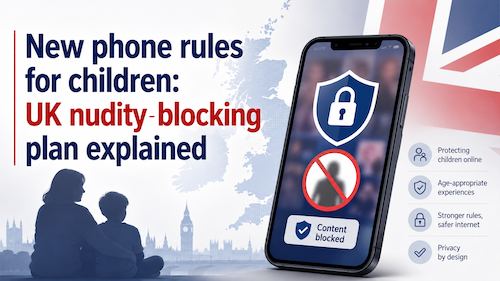
The government has proposed new phone rules for children that would make smartphones and tablets block nude images at device level. The plan is not law yet, and parents do not need to change devices immediately.
The Home Office says major tech companies, including Apple and Google, should activate built-in features or implement technical solutions on smartphones and tablets to detect and block nude images for children.
Prime Minister Keir Starmer announced the plan at London Tech Week on Monday, 8 June. The government says the aim is to stop children taking, sharing, receiving or viewing nude images, including where predators try to coerce or blackmail them.
This would be different from ordinary app-by-app parental controls. Ministers want the protection to work at device or operating system level, so it can apply across more than one service.
In the House of Commons, a science and technology minister said the expected protections would cover core device functions including the camera, messaging apps, search functions and file sharing, and would be built directly into the operating system.
No. This is a government demand and policy proposal, not a new law already in force.
The government says tech companies have three months to show they will introduce the safeguards. If they do not, ministers say they will bring forward legislation to force the technology to be activated.
The Home Office said any legislation could include fines for companies. It also said criminal liability for tech bosses is being explored as a last resort.
That means the details have not yet been finalised in a published law. A bill, regulations or enforceable technical standard would still be needed if voluntary action does not satisfy the government.
The government says the changes would apply to UK devices, including both existing and newly sold smartphones and tablets.
The most obvious companies affected would be Apple and Google, because iOS, iPadOS and Android run most phones and tablets used by children. The Home Office also said legislation could cover operating system providers and others in the supply chain, such as retailers.
The announcement does not set out a final list of models, software versions or manufacturers. It also does not explain how older devices without current software support would be treated.
The proposal is aimed at nude and sexually explicit imagery. Ministers say the system should stop children taking, sharing or viewing nude content, rather than merely warning them or blurring images in selected apps.
The Home Office specifically pointed to gaps in existing protection, including cameras, broader apps, third-party messaging services and search functions.

The White House sent Congress the text of an interim U.S.-Iran agreement, Reuters reported. The document sets a 60-day negotiating window while leaving Iran’s nuclear program, sanctions and the deal’s durability unresolved.

The House rejected a short-term extension of FISA Section 702, leaving a major surveillance authority at its June 12 deadline. Here is what Section 702 does, what expires and what Congress can do next.
Some safety tools already exist. Apple says its Communication Safety feature already blurs nudity when detected in Messages and FaceTime and is turned on by default for users under 18. The government says that kind of protection does not go far enough because it is not applied across the whole device.
Reuters reported that Google said it was working constructively with UK partners on privacy-preserving solutions. Apple did not comment to Reuters on the government announcement.
The government says adults would still be able to take, share or view nude content if they verify their age.
Ministers have also said companies must introduce the measures without threatening privacy or collecting data, and that the device should simply block harmful content across apps and services.
That leaves an important practical question: how age checks would be made reliable, proportionate and privacy-preserving. Ofcom’s existing online safety guidance says age assurance can include age verification and age estimation. Online services likely to be accessed by children already have duties under the Online Safety Act to protect children from pornography and other priority harmful content.
The new phone proposal goes further than many existing platform rules because it targets the device itself. The government has not yet published a detailed technical specification explaining exactly how checks would be handled by Apple, Google, app developers or retailers.
The plan sits alongside the Online Safety Act and the government’s wider review of children’s online lives.
The Department for Science, Innovation and Technology consultation, Growing up in the online world, asked about age restrictions on features including livestreaming, disappearing content, location sharing, connecting with strangers and the ability to send nude images or videos.
That consultation has closed, and the government says it will publish its response soon. The phone proposal is therefore part of a broader push around age assurance, social media features and children’s exposure to harmful content.
It should not be confused with an immediate ban on children owning phones, an automatic shutdown of messaging apps or a completed under-16 social media ban.
Parents should keep using existing safety settings while the policy is worked through.
On iPhones and iPads, that means checking Family Sharing, Screen Time, Communication Safety, web content limits and app age restrictions. On Android devices, parents can review Family Link, Play Store controls, SafeSearch and app permissions.
Families should also check that a child’s account age is accurate, because many protections depend on whether the device or app knows a user is under 18. For younger children, a child account or supervised account is usually safer than a standard adult account with ad-hoc restrictions.
The next things to watch are whether Apple, Google and other device or operating system providers agree to a UK implementation plan, and whether the government publishes draft legislation. Until then, the proposal is significant, but it is still a policy plan rather than a rule parents can rely on today.
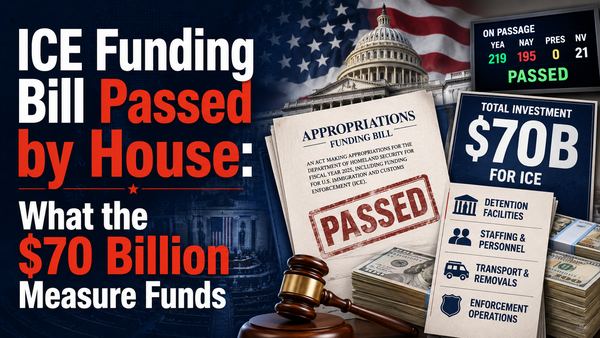
The House passed S. 2, the Secure America Act, a nearly $70 billion immigration-enforcement funding bill for ICE, Border Patrol and DHS through fiscal 2029. The measure now goes to President Donald Trump after a 214-212 House vote.