 orywire
News that matters globallyReporting on public life and major developments across the U.S., the UK, and beyond.
orywireThe Supreme Court sided with the FCC in a case over AT&T and Verizon location-data fines, preserving the agency’s forfeiture process. The ruling explains when companies can challenge FCC penalties and what it means for telecom privacy enforcement.
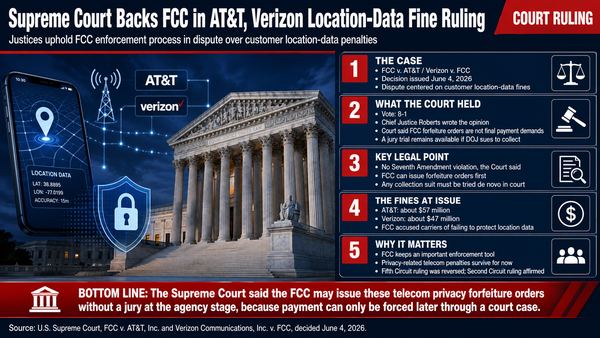
The Supreme Court backed the FCC in a ruling over AT\&T and Verizon location-data fines, leaving intact the agency’s ability to issue forfeiture orders without first holding a jury trial. For wireless customers, the decision does not require immediate action, but it matters for how federal regulators enforce privacy rules against telecom companies.
The court ruled June 4 that the FCC’s forfeiture process, as used against AT\&T and Verizon, does not violate the Seventh Amendment right to a jury trial. Chief Justice John Roberts wrote the opinion for an 8-1 court, with Justice Clarence Thomas dissenting.
The decision turned on a narrow but important point: an FCC forfeiture order does not, by itself, finally settle whether a company must pay. The court said the agency’s findings are not conclusive, and if the government needs to collect an unpaid penalty, it must bring a civil case where the company can contest the case again.
The ruling reversed a Fifth Circuit decision that had sided with AT\&T and sent that case back for more proceedings. It affirmed a Second Circuit ruling that had upheld the FCC process in Verizon’s case.
The case grew out of the FCC’s 2024 orders involving customer location information. The agency imposed a $57,265,625 penalty against AT\&T and a $46,901,250 penalty against Verizon after finding that the carriers failed to take reasonable steps to protect customers’ location data.
The FCC said the carriers’ location-based services programs allowed access to customer location information through intermediaries known as aggregators. Those aggregators then provided access to third-party location-based service providers. The agency said the carriers did not adequately ensure valid customer consent and continued the programs after learning that safeguards were ineffective.
The broader FCC action also included T-Mobile and Sprint, which had merged by the time the fines were announced. The agency said the four carriers were fined nearly $200 million combined for illegally sharing access to customer location information without consent and without reasonable safeguards.
AT\&T and Verizon did not ask the Supreme Court to decide a simple customer privacy question. Their constitutional argument focused on the process the FCC used to assess the penalties.
The carriers argued that the agency had effectively found facts, applied the law and imposed punishment without giving them a jury trial first. That argument drew on the Seventh Amendment, which preserves the right to a jury trial in certain civil cases.
The FCC and the federal government answered that the agency’s order is not the last word. Under the Communications Act, if a company does not pay a forfeiture order, the government must go to court to collect. In that collection case, the court said, the government must prove its case in a fresh trial.
The majority treated the FCC order as a preliminary enforcement step, not as a final court judgment. The opinion said the FCC cannot seize assets or otherwise execute on the order by itself, and nonpayment does not create the same immediate consequences as a final judgment.
That distinction helped the court separate the FCC case from the Supreme Court’s 2024 decision involving the Securities and Exchange Commission. In that SEC case, the court limited the agency’s use of in-house proceedings for civil penalties. Here, the court said the FCC system is different because the government still needs a court case to force payment of an unpaid forfeiture.
The result does not mean every agency penalty process is constitutional. It means this FCC forfeiture path, under this statute and in this posture, survived the carriers’ jury-trial challenge.
The decision preserves an important FCC enforcement tool. The agency can continue using forfeiture orders to announce and assess penalties against regulated communications companies when it believes the Communications Act or FCC rules have been violated.
For privacy enforcement, the ruling is significant because the underlying fines involved real-time customer location information, one of the most sensitive categories of wireless data. The FCC has said carriers must protect certain customer information, maintain confidentiality and obtain affirmative customer consent before allowing access to that information in covered circumstances.
The decision does not create a new customer privacy law. It also does not decide every possible challenge to future FCC penalties. Companies can still contest agency orders, and the government still faces the burden of proving its case if it seeks to collect an unpaid forfeiture in court.
Wireless customers do not need to file anything because of the Supreme Court ruling. The decision is about regulatory enforcement, not a new claims process for individual customers.
The practical takeaway is that the federal fight over location-data safeguards is not over simply because the FCC issued fines. The ruling confirms that the FCC can use its existing enforcement process, while also making clear that companies have court options if the government tries to collect unpaid penalties.
Customers concerned about location privacy can still review carrier privacy controls and app-level location permissions. The ruling itself, however, does not require AT\&T or Verizon customers to change service, update devices or submit a form.
The AT\&T case returns to the lower court after the Supreme Court reversed the Fifth Circuit. Verizon’s Supreme Court outcome is different because the court affirmed the Second Circuit’s decision.
The justices did not decide whether AT\&T or Verizon should receive any refund or what relief might be available in a later proceeding. The opinion expressly left that issue open.
Future updates are likely to come from lower-court filings, FCC enforcement actions or company statements. For now, the most important point is that the Supreme Court left the FCC’s forfeiture process standing in the AT\&T and Verizon location-data fine cases.