 orywire
News that matters globallyReporting on public life and major developments across the U.S., the UK, and beyond.
orywireThe government has opened a call for evidence to shape new screen-use guidance for children aged 5 to 16 in England. Final guidance is expected in autumn, but daily limits and smartphone advice are not yet final.
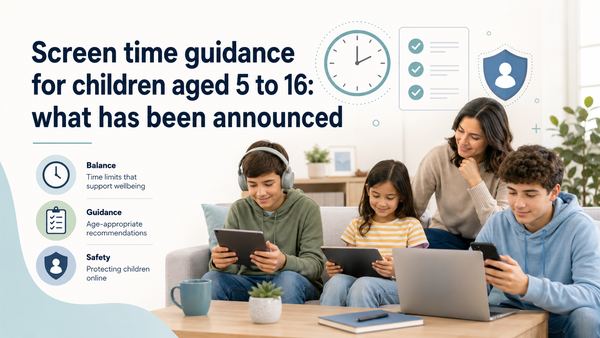
The government has not yet issued final screen time limits for children aged 5 to 16. It has opened a three-week call for evidence to help shape new parent-facing guidance, which the Department for Education says will be published this autumn.
The Department for Education (DfE) says parents and carers will receive practical, evidence-based guidance on healthy screen use for children aged 5 to 16.
The guidance could include advice on issues such as when a child should get their first smartphone, as well as screen use around social media, sleep, learning and family life. Ministers say the aim is to help families make informed choices rather than impose a single rule for every child.
The work will be informed by an independent expert group co-chaired by Children’s Commissioner Dame Rachel de Souza and Professor Russell Viner. The call for evidence is intended to gather research and professional evidence before the guidance is written.
The call for evidence applies to England and focuses on children and young people aged 5 to 16.
The final guidance is expected to be aimed at parents and carers. Schools are also part of the evidence-gathering process because the government is seeking views on how screens are used in education and how that should shape future policy.
The evidence call asks for age-specific information where possible, including for children aged 5 to 7, 8 to 11, 11 to 12, 13 to 14 and 15 to 16. For school settings, the government is also looking at screen use from reception to KS4 (Key Stage 4), covering ages 4 to 16.
Children under five are covered by separate government guidance that has already been published.
The DfE says the 5 to 16 guidance will be published in autumn 2026.
The call for evidence opened on 8 June 2026. The GOV.UK page and the DfE consultation portal list the closing date as 29 June 2026.
Parents should not treat this announcement as a new national daily screen time limit for older children. The government has not yet finalised an age for first smartphone ownership, a daily screen time cap, or detailed rules for different types of screen use.
The call for evidence asks for research on both the benefits and risks of screen use. It covers health, development, wellbeing, behaviour and learning, and asks how the impact can vary by age, timing, type of activity and pattern of use.
The government says it is interested in the full range of children’s digital experiences, including social media, gaming, educational technology, AI (artificial intelligence), smart devices and interactive tools.
It is also asking for evidence on problematic or compulsive screen use, the role of parents and home routines, support that helps families manage screen use, and differences between groups of children. That includes children with SEND (special educational needs and disabilities), children with protected characteristics and children from different socio-economic backgrounds.

The White House sent Congress the text of an interim U.S.-Iran agreement, Reuters reported. The document sets a 60-day negotiating window while leaving Iran’s nuclear program, sanctions and the deal’s durability unresolved.

The House rejected a short-term extension of FISA Section 702, leaving a major surveillance authority at its June 12 deadline. Here is what Section 702 does, what expires and what Congress can do next.
For schools, the evidence call asks how screen-based activity affects learning, behaviour, wellbeing, homework, device access and the balance between classroom screen use and home screen use.
This call for evidence is separate from the government’s broader “Growing up in the online world” consultation, which ran from March to May 2026. GOV.UK now lists that consultation as closed, with feedback being analysed.
That wider consultation looked at bigger policy questions, including possible age restrictions for social media, risky platform features, age checks, the digital age of consent and whether school mobile phone guidance should be put on a statutory footing.
The new 5 to 16 screen-use work is narrower. It is designed to inform guidance for parents and future thinking on screens in schools. It does not, by itself, introduce a social media ban, an app curfew or a compulsory screen time limit.
For now, parents of children aged 5 to 16 should treat the announcement as the start of the guidance process, not the final advice.
Families can still review everyday routines around sleep, homework, gaming, social media, physical activity and conversations about what children see online. The government’s existing under-fives guidance remains separate and should not be applied automatically to older children.
Researchers, health professionals, education specialists, charities and sector organisations with relevant evidence can respond to the call for evidence before the closing date listed on GOV.UK.
This article should be updated when the call for evidence closes, when the government responds to the wider online safety consultation, and when the final screen-use guidance for 5 to 16-year-olds is published.
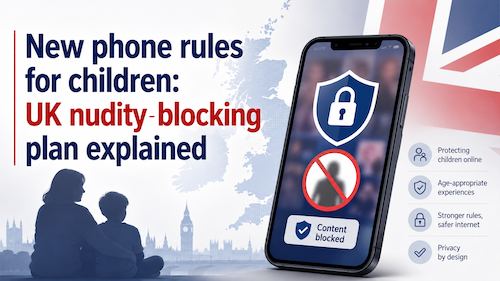
The government wants device-level nudity blocking on children’s smartphones and tablets. The plan is not law yet, but tech firms have been given three months to act before ministers consider legislation.