 orywire
News that matters globallyReporting on public life and major developments across the U.S., the UK, and beyond.
orywireThe House passed S. 2, the Secure America Act, a nearly $70 billion immigration-enforcement funding bill for ICE, Border Patrol and DHS through fiscal 2029. The measure now goes to President Donald Trump after a 214-212 House vote.
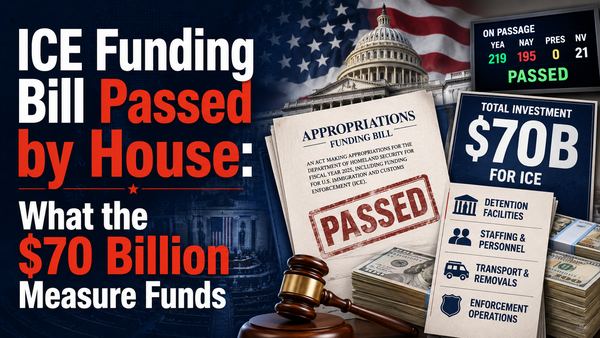
The House passed S. 2, the Secure America Act, a nearly $70 billion immigration-enforcement funding bill that would finance ICE, Border Patrol and other Department of Homeland Security operations through fiscal 2029. The measure still needs President Donald Trump’s signature to become law.
S. 2 is a funding bill, not a broad immigration reform package. It would provide multi-year money for U.S. Immigration and Customs Enforcement, U.S. Customs and Border Protection and related DHS costs.
House Clerk records show the bill passed Tuesday by a 214-212 vote. Republicans supplied all 214 yes votes; 211 Democrats and one independent voted no, and four lawmakers did not vote.
The Senate had already passed the measure last week. Republicans used budget reconciliation, a process that can allow budget-related legislation to move through the Senate by a simple majority rather than the 60 votes usually needed to overcome a filibuster.
The bill text totals about $69.5 billion, commonly rounded to $70 billion. The White House described the package as $38 billion for ICE, $26 billion for Border Patrol and $5 billion in additional DHS appropriations for unforeseen costs.
ICE: about $38.5 billion across two sections of the bill, including $31.075 billion for immigration enforcement activities and $7.45 billion for Homeland Security Investigations work outside its immigration and customs enforcement missions.
Border Patrol and CBP: about $26 billion routed through Customs and Border Protection, the agency that includes the Border Patrol. The money covers personnel, immigration-enforcement operations, border technology and screening.
Additional DHS funding: $5 billion split into two $2.5 billion appropriations for other Homeland Security purposes tied to the bill.
The money in the measure would remain available until September 30, 2029.
The ICE enforcement section covers hiring, paying, training and equipping ICE personnel across its directorates, including officers, agents, investigators, attorneys and support staff.
It also funds transportation and removal operations, information technology, fee-collection improvements, body-worn cameras, facility maintenance, fleet maintenance and expansion of 287(g) agreements, which allow certain state and local officers to perform some immigration-enforcement functions under federal supervision.
The bill sets aside at least $350 million for ICE operations tied to detainers, custodial transfers, release monitoring, transportation and arrests of certain people encountered in jurisdictions that the measure defines as not qualified cooperating jurisdictions.
A separate ICE section provides $7.45 billion for Homeland Security Investigations agents and support personnel. That section includes $108.5 million for additional child-exploitation investigators and forensic analysts, and says the money is for functions outside HSI’s immigration and customs enforcement missions.
For Customs and Border Protection, the bill includes $9.55 billion for Border Patrol agents and support personnel. It also includes $13.02 billion for CBP agents and support staff to carry out immigration enforcement activities.
Another $3.45 billion would go toward border security, technology and screening. The listed uses include non-intrusive inspection equipment, artificial intelligence and machine-learning tools, Air and Marine Operations upgrades, border surveillance technology, biometric entry-exit work and efforts to combat drug trafficking, including fentanyl and precursor chemicals.
The bill also includes restrictions on certain surveillance towers, saying the funds cannot be used for towers along the southwest and northern borders that have not been tested and accepted by CBP to deliver autonomous capabilities.
Because both chambers have passed the measure, the next step is action by the president. The White House Office of Management and Budget said before final House passage that senior advisers would recommend signing S. 2 if it were presented to Trump in its current form.
Once signed, the bill would become law and DHS agencies could begin using the money under the terms Congress approved. The practical rollout would then depend on agency implementation: hiring plans, contracts, technology purchases, detention and removal operations, and any spending instructions DHS issues after enactment.
Until the president signs it, the bill is not yet law.
Republicans framed the package as necessary funding for immigration enforcement, border security and law-enforcement operations after months of conflict over DHS money.
Democrats opposed the bill, arguing that it provides a large funding increase without the operational changes they wanted for ICE and other immigration-enforcement agencies. AP reported that Democrats had sought changes including visible identification for agents and warrant requirements before entry onto private property; those demands were not included in the final funding bill.
The fight also followed a broader funding standoff over DHS. Reuters reported that a partial shutdown of the department earlier this year ended after a separate bipartisan bill funded DHS agencies not involved in the administration’s immigration crackdown through the end of the fiscal year.
The immediate item to watch is whether and when the White House posts a signed-law notice. After that, the next public milestones will be agency spending plans, hiring or procurement announcements, congressional oversight and any court challenges or policy disputes tied to how the new money is used.
The bill’s broadest effect is that it would move a large part of immigration-enforcement funding outside the usual year-to-year appropriations fight through September 2029.
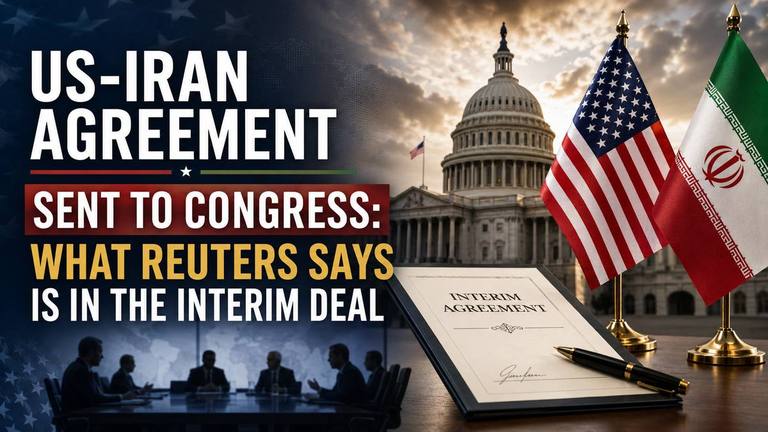
The White House sent Congress the text of an interim U.S.-Iran agreement, Reuters reported. The document sets a 60-day negotiating window while leaving Iran’s nuclear program, sanctions and the deal’s durability unresolved.
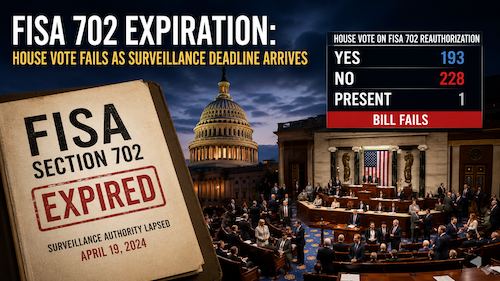
The House rejected a short-term extension of FISA Section 702, leaving a major surveillance authority at its June 12 deadline. Here is what Section 702 does, what expires and what Congress can do next.

The government wants device-level nudity blocking on children’s smartphones and tablets. The plan is not law yet, but tech firms have been given three months to act before ministers consider legislation.