 orywire
News that matters globallyReporting on public life and major developments across the U.S., the UK, and beyond.
orywireThe NTSB’s preliminary report says United Flight 169 struck a light pole while approaching Runway 29 at Newark Liberty International Airport, and debris from the pole hit a tractor-trailer. The plane landed safely with no injuries onboard, but the investigation has not reached a final cause.
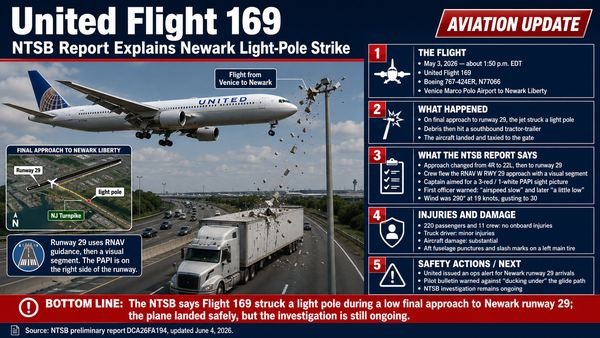
United Flight 169 struck a light pole over the New Jersey Turnpike as it was landing at Newark Liberty International Airport, according to the NTSB’s preliminary report. The report says debris from the pole, not the jet itself, later hit a tractor-trailer; everyone on the plane deplaned safely, while the truck driver had minor injuries.
The May 3 flight was a United Airlines Boeing 767-424ER arriving from Venice, Italy, to Newark. The NTSB said the aircraft, registration N77066, was on final approach to Runway 29 when it struck the light pole at about 1:50 p.m. EDT.
The aircraft landed and taxied to the gate without further incident. The report lists 3 flight crew members, 8 cabin crew members and 220 passengers, all without injury.
The NTSB described the damage to the aircraft as substantial. The FAA’s incident statement also said the Boeing 767 landed safely and that the NTSB is leading the investigation.
Early accounts of the incident focused on a truck traveling on the Turnpike below the approach path. The NTSB’s preliminary report narrows that account: it says debris from the light pole subsequently impacted a southbound tractor-trailer.
Investigators reported damage to the truck’s windshield and trailer, including punctures in the aluminum siding. The report also says there was no evidence of tire marks on the tractor cab or trailer.
That distinction matters because the preliminary report does not say the aircraft directly hit the truck. It says the aircraft hit the light pole, and debris from the pole then struck the vehicle.
The report gives a first detailed look at what the crew recalled during the final moments of the approach. The captain told investigators he turned off the autopilot and auto-throttles around 880 feet mean sea level, near a point on the approach called AXELL.
The captain said he “got fast” while turning the airplane into the headwind and pulled the power levers back to compensate. The report says the airspeed later began to decay.
The first officer recalled saying, “hey you are slow,” and then, moments later, “you are still slow and a little low.” He later told investigators he thought the aircraft was low, but that the plane was about to touch down and he did not process the situation in time to call for a go-around.
The captain told investigators he heard a thump just before touchdown. Other crew members also recalled a jolt or loud bang just before landing, according to the report.
The NTSB said Runway 29 at Newark does not have a precision Instrument Landing System, or ILS, approach. An RNAV approach, which uses area navigation guidance, is available until pilots reach a point where they continue visually.
The report also discusses PAPI lights, or Precision Approach Path Indicators, which show pilots whether they are above or below the desired glide path. On Runway 29, the PAPI lights are located on the right side of the runway, rather than the left side where they are normally found.

The FAA is investigating after Delta Air Lines Flight 2351 executed a go-around at Boston Logan while another aircraft was departing from an intersecting runway. Delta said the flight landed safely and passengers deplaned normally.
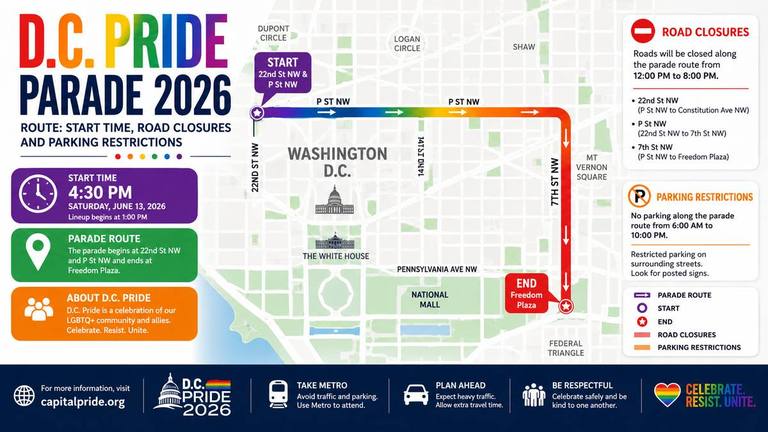
The Capital Pride Parade steps off Saturday, June 20, with closures affecting 14th Street NW, Pennsylvania Avenue NW and downtown routes. Here is what drivers, residents and Metro riders need to know before heading out.
Weather was also part of the record reviewed by investigators. The last airport weather report before landing showed wind from 290 degrees at 19 knots, gusting to 30 knots, with 10 statute miles of visibility. The NTSB said postaccident inspection showed all three altimeters were accurately set.
The NTSB said the aircraft had three punctures in the left lower aft fuselage, along with dents and creases. A tire on the left main landing gear showed evidence of slash marks.
After the accident, the report says United Flight Operations issued an operations alert specific to Newark arrivals and the RNAV vertical guidance for Runway 29. United also issued a pilot bulletin on short-runway landing guidance.
The bulletin described a hazard involving “ducking under,” a technique the report says can contribute to low approach altitudes during the visual segment at some airports and runways. The bulletin emphasized that approaches should be flown so touchdown occurs 1,500 feet from the runway threshold, but not before 1,000 feet.
The NTSB’s report is preliminary and says the information is subject to change. It does not assign a probable cause, determine fault or make final safety recommendations.
Investigators have downloaded the flight data recorder and cockpit voice recorder, and the report says the investigation is ongoing. The next major update would come from further NTSB findings, a final report or any additional official safety actions from the FAA, United or airport authorities.
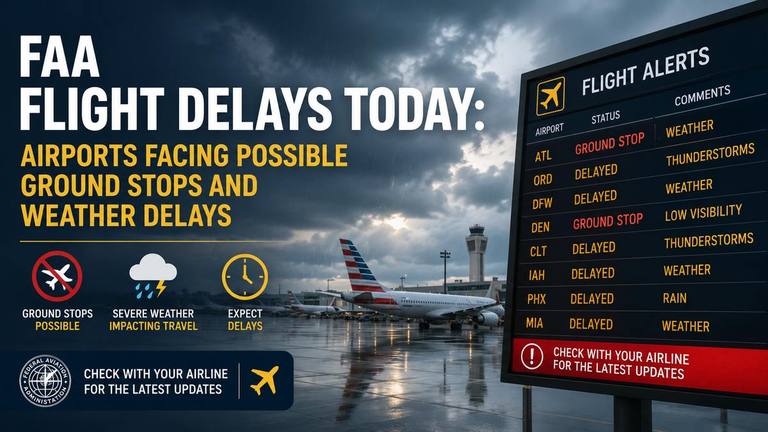
The FAA’s current operations plan lists several airports where weather or event volume could trigger ground stops or ground delay programs today. Travelers should check airline apps and official airport or FAA status pages before heading to the airport.