 orywire
News that matters globallyReporting on public life and major developments across the U.S., the UK, and beyond.
orywireThe U.S. says it struck Iranian air defense and radar sites near the Strait of Hormuz after a U.S. Army Apache helicopter went down near Oman. Iran then claimed retaliatory attacks on U.S.-linked bases in Bahrain, Kuwait and Jordan, while key details of the helicopter incident remain under investigation.
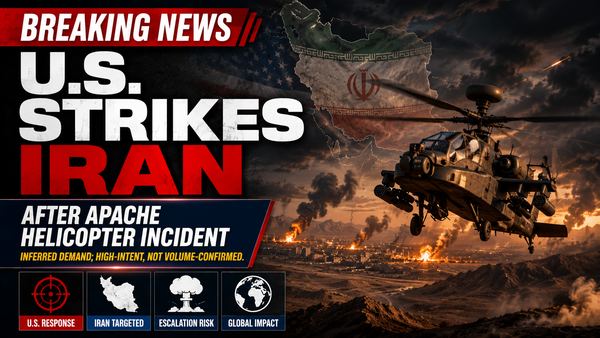
The U.S. says it carried out strikes on Iranian military sites near the Strait of Hormuz after a U.S. Army Apache helicopter went down near Oman. Two crew members were rescued and are in stable condition, according to U.S. Central Command, while Iran later claimed retaliatory attacks on U.S.-linked bases in the region.
The episode marks a sharp escalation in the U.S.-Iran confrontation and comes with several important caveats: the U.S. military says the helicopter incident remains under investigation, battlefield damage assessments are still limited, and competing claims from Washington and Tehran have not all been independently verified.
U.S. Central Command said two crew members from a U.S. Army AH-64 Apache were rescued after their helicopter went down near the coast of Oman while patrolling regional waters.
CENTCOM said the soldiers were rescued within about two hours and were in stable condition. The command said the rescue effort involved U.S. Naval Forces Central Command, the 82nd Airborne Division, U.S. Air Force and Navy units, and Task Force 59, the Navy unit focused on uncrewed systems in the region.
President Donald Trump blamed Iran for the incident, saying the helicopter had been shot down while patrolling over the Strait of Hormuz. Reuters and the Associated Press reported, citing U.S. officials speaking on condition of anonymity, that the helicopter was brought down after contact with an Iranian drone. Official U.S. military statements, however, have said the cause remains under investigation.
That distinction matters. At this stage, the public record supports that a U.S. Apache went down, that both crew members survived, and that the U.S. blamed Iran. It does not yet establish in public detail whether the collision or downing was intentional.
CENTCOM said U.S. forces completed what it called self-defense strikes against Iran on June 9 at the direction of the commander in chief. The command said the strikes were a response to the previous day’s downing of the Apache.
The targets, according to CENTCOM, included Iranian air defense sites, ground control stations and surveillance radar sites near the Strait of Hormuz. The command said U.S. Air Force and Navy fighter jets used precision munitions.
CENTCOM described the operation as a proportional response to recent attacks on U.S. forces and international commercial ships in regional waters. Reuters reported that the strikes began around 5 p.m. ET and that CENTCOM posted shortly before 9 p.m. ET that the operation had ended.
The U.S. has not publicly released a full list of sites hit, a detailed damage assessment or any confirmed casualty count from the strikes.
After the U.S. strikes, Iran’s Revolutionary Guards said they launched missile and drone attacks on U.S. military targets in Bahrain, Kuwait and Jordan, according to Reuters.
Jordan’s official news agency reported that Jordanian air defense systems intercepted and shot down five missiles launched from Iran toward the Azraq region in Zarqa Governorate. The report said debris fell but that no human casualties or material damage were reported.
Kuwait’s government said its air defense systems were engaging hostile objects and urged residents to follow official safety instructions. Reuters also reported that Kuwait and Bahrain activated or used air defenses after Iranian attacks were claimed.
A U.S. official told Reuters that initial assessments showed nearly all Iranian missiles and drones were intercepted, with no immediate reports of harm to U.S. personnel or damage to U.S. facilities. Reuters said it could not immediately verify battlefield reports.
Several major questions remain open.
The first is the exact cause of the Apache incident. CENTCOM has said the cause is under investigation, while Reuters and AP reported Iranian drone involvement based on U.S. officials who were not named because the inquiry was ongoing.
The second is the extent of damage inside Iran. CENTCOM identified the types of targets it struck but did not provide a detailed public assessment of damage or casualties.
The third is the effect of Iran’s response. Jordan said it intercepted five missiles without casualties or damage, and Kuwait said its air defenses were engaging hostile objects. A broader U.S. and regional assessment may change as more official statements are released.
The fourth is whether the latest exchange closes or further narrows any diplomatic path. Reuters reported that Iran’s Foreign Ministry said Tehran would reassess diplomatic engagement with Washington after what it called ceasefire violations.
The Strait of Hormuz is one of the world’s most important energy corridors and a central flashpoint in the confrontation. It sits between Iran and Oman and connects the Persian Gulf with the Gulf of Oman and the Arabian Sea.
Reuters reported that before the war, the strait carried about a fifth of the world’s crude oil and liquefied natural gas. Any military escalation there can raise concerns about shipping security, energy prices and the safety of U.S. forces and regional allies.
That is why an aircraft incident near Oman, U.S. strikes on Iranian military systems near the strait and Iranian claims of attacks on U.S.-linked regional bases all carry broader consequences beyond the immediate battlefield.
The next key updates are likely to come from CENTCOM, the Pentagon, regional governments and wire services with reporters in the area.
The most important details to watch are whether the U.S. releases more information on the Apache investigation, whether Iran provides evidence for its claims of retaliatory strikes, whether any casualties or damage are confirmed, and whether Washington or Tehran signals additional military action.
For now, the clearest verified picture is this: the Apache crew survived, the U.S. struck Iranian military systems near the Strait of Hormuz, Iran claimed a retaliatory response across the Gulf region and Jordan, and several critical facts remain under official review.