 orywire
News that matters globallyReporting on public life and major developments across the U.S., the UK, and beyond.
orywireCDC says certain travelers who were recently in the Democratic Republic of the Congo, Uganda or South Sudan may be routed to four U.S. airports for enhanced Ebola screening. The agency says the U.S. risk remains low, but affected travelers should monitor symptoms for 21 days after leaving those countries.

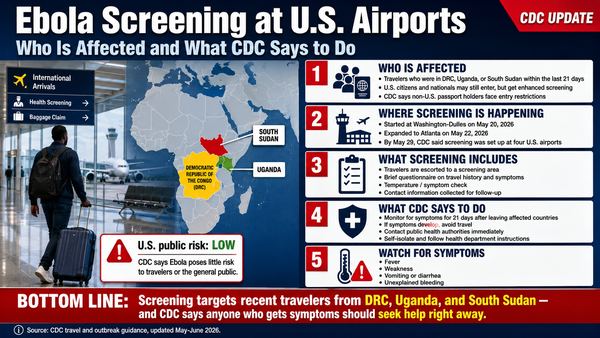
The Centers for Disease Control and Prevention is using enhanced Ebola screening at four U.S. airports for travelers who were recently in the Democratic Republic of the Congo, Uganda or South Sudan. Most U.S. travelers are not affected, but anyone who was in those countries in the 21 days before arrival should expect possible rerouting, screening at the airport and health-monitoring instructions.
CDC’s current-situation page, dated June 4, says no Ebola cases connected with this outbreak have been confirmed in the United States and that the overall risk to the American public and travelers remains low.
Affected air passengers are being routed to four airports, CDC says:
Airlines will work with affected travelers to rebook flights. CDC says passengers whose trips were already booked to land at one of the designated airports will not be redirected to another designated airport simply because of the screening rule.
The screening and routing rules focus on people who were in DRC, Uganda or South Sudan within 21 days before arriving in the United States. CDC says U.S. citizens and U.S. nationals may still enter but will undergo enhanced public health screening if they fall into that group.
The agency also says certain non-U.S. citizens who were in those countries during the previous 21 days are temporarily prohibited from entering. A May 22 HHS rule update extended the temporary restriction to lawful permanent residents, or green-card holders, who were in DRC, Uganda or South Sudan within the same 21-day period.
Travelers with complicated itineraries should not decide on their own whether a stop counts. CDC says the Department of Homeland Security determines whether someone who transited through one of the countries, or remained on the plane during a stop there, is considered to have been in that country for redirection.
At the airport, travelers may be escorted to a screening area, answer a short questionnaire about travel history and symptoms, have their temperature checked with a non-contact thermometer and be observed by CDC staff for signs of illness.
CDC may collect contact information for follow-up by state or local health departments. Travelers without symptoms generally receive instructions for health monitoring and continue to their final destination after screening.
If a traveler has a fever or other symptoms that could fit Ebola, a CDC public health officer conducts an additional evaluation. If the assessment suggests the traveler may be sick with Ebola, the person is transferred to a hospital for medical evaluation and isolation.
Before traveling, affected passengers should check their airline reservation and watch for rebooking notices. CDC says airlines will work directly with travelers whose flights need to be rerouted. CDC also says it does not reimburse costs from redirection, so refunds, credits or other accommodations are handled by airlines, travel providers or insurers.
After leaving an affected country, travelers should monitor their health for 21 days. CDC’s guidance says anyone who develops symptoms such as fever, weakness, vomiting, diarrhea or unexplained bleeding should not travel and should contact public health authorities or a health care facility immediately. Calling ahead helps health workers prepare and protect others.
For planned travel, CDC has a Level 3 travel notice for the DRC outbreak area and recommends avoiding nonessential travel to Ituri, Nord-Kivu and Sud-Kivu provinces. Uganda is under a Level 2 notice advising enhanced precautions.
The current outbreak is in parts of DRC and Uganda. CDC says South Sudan has not reported cases in the current outbreak, but it is included in the U.S. measures because it shares borders with affected countries.
Ebola spreads through direct contact with blood or other body fluids of a person who is sick or has died from the disease, or through contaminated objects. CDC is using screening, overseas exit checks, airline illness reporting and post-arrival monitoring as a layered approach.
Screening does not catch every possible case. CDC says symptoms can develop up to 21 days after exposure, so a traveler who is infected but not yet showing symptoms may not be identified at the airport. That is why follow-up monitoring remains part of the response.
CDC describes the suspension as temporary and currently set to remain in effect for 30 days while a public health risk assessment is completed. The agency says it may adjust public health measures as more information becomes available.
Travelers should recheck CDC travel notices and airline instructions before departure, especially if they recently traveled in DRC, Uganda or South Sudan. Readers should look for updated guidance if CDC changes the airport list, affected countries, entry restrictions, travel notices or U.S. risk assessment.
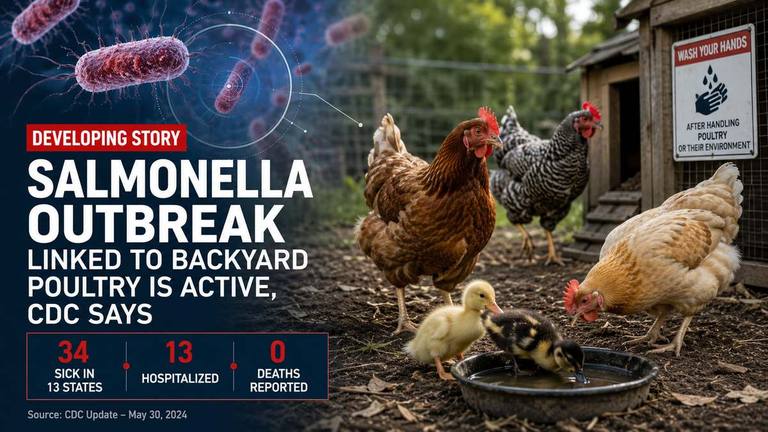
CDC says multistate Salmonella outbreaks linked to backyard poultry remain open, with 513 reported illnesses, 134 hospitalizations and one death. Families and flock owners are urged to wash hands, keep birds outside the home and keep young children away from chicks and ducklings.
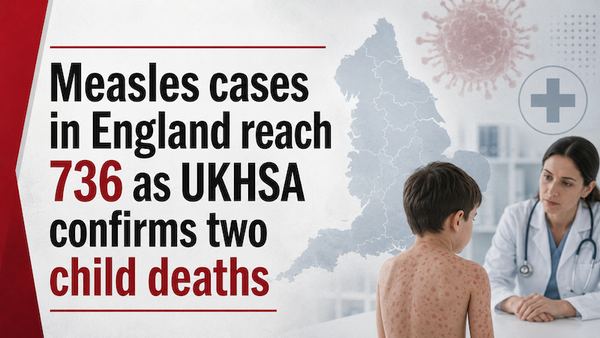
UKHSA says England has recorded 736 laboratory-confirmed measles cases so far in 2026, with two child deaths confirmed. The latest figures show recent activity has been highest in London, the East of England and the West Midlands.
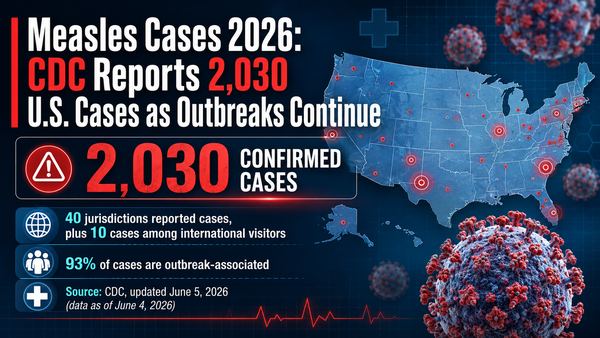
The CDC says 2,030 confirmed measles cases have been reported in the United States in 2026, with most cases tied to outbreaks. The latest update also explains why state counts may differ from the national total.