 orywire
News that matters globallyReporting on public life and major developments across the U.S., the UK, and beyond.
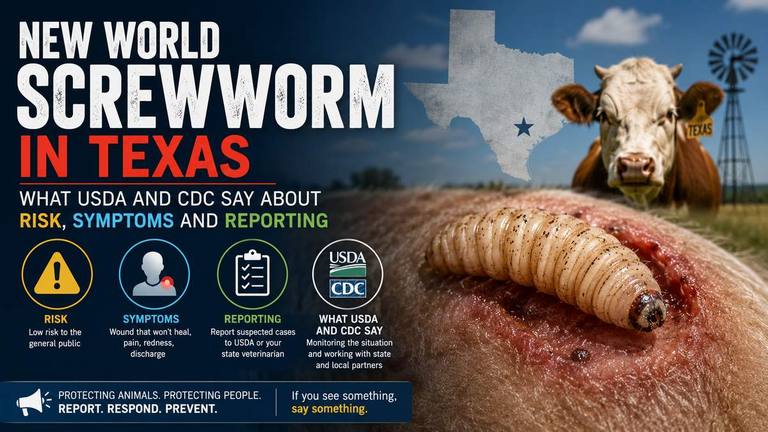
orywireUSDA confirmed New World screwworm in a calf in Zavala County, Texas. Officials say animal owners should monitor livestock and pets, follow movement restrictions in the affected zone and report suspected cases quickly.
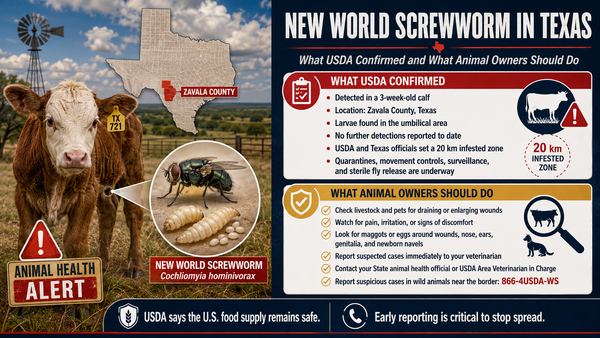
USDA confirmed New World screwworm in a 3-week-old calf in Zavala County, Texas, and state officials say no further confirmed animal detections have been reported in Texas. Livestock and pet owners in the affected zone should monitor animals for wounds or larvae and should not move animals from the quarantine area without Texas Animal Health Commission authorization.
The U.S. Department of Agriculture’s Animal and Plant Health Inspection Service said the detection was confirmed June 3 in a bovine in Zavala County. Texas officials said the sample came from a three-week-old calf with an umbilical lesion and was confirmed by the National Veterinary Services Laboratories in Ames, Iowa.
The Texas Animal Health Commission said this is the first Texas detection tied to the recent northward progression of New World screwworm from Central America, which officials have been tracking since 2023.
New World screwworm is not an ordinary wound maggot. Officials describe it as the larvae of a parasitic fly that can burrow into living tissue, causing the painful condition known as myiasis. It primarily affects livestock but can also affect pets, wildlife, birds and, less commonly, people.
The Texas Animal Health Commission established Infested Zone 01 in the Zavala and Uvalde County areas after the detection. A state order says warm-blooded animals inside that zone may not be moved out without prior authorization from the commission.
In general, animals must be inspected, treated as required and issued a permit or certificate before movement outside the zone. The order also applies to hides, carcasses and animal parts that could serve as hosts for New World screwworm.
Animal owners should not try to work around those restrictions. The state order says unauthorized movement is prohibited and may lead to administrative penalties or criminal prosecution.
Officials are urging animal owners to look closely at wounds and body openings. The Texas Animal Health Commission says owners should check livestock for flies, maggots, larvae or eggs and monitor the nose, ears, umbilicus and genitalia for drainage or enlargement.
USDA also advises watching for draining or enlarging wounds and signs of discomfort. Newborn animals can be vulnerable because the navel can attract flies.
Animal owners should keep open wounds clean and covered, work with a veterinarian on prevention and treatment, and inspect pets and vehicles when traveling in areas where New World screwworm may be present.
Suspected livestock cases should be reported to the Texas Animal Health Commission veterinarian on call at 1-800-550-8242. The agency says suspected New World screwworm is reportable within 24 hours, and TAHC or USDA must be contacted for official identification submissions.
For wildlife concerns, Texas officials direct residents to the Texas Parks and Wildlife Department. For suspected human infestation, they direct residents to the Texas Department of State Health Services.
USDA and Texas officials say they are working through a joint incident response. Federal and state partners are conducting animal and fly surveillance, epidemiological investigations and local outreach in the infested zone.
USDA said the response includes a unified incident command team with the Texas Animal Health Commission, movement controls, surveillance and increased trapping near the border and outside the fly-dispersal area.
The agency also said it is expediting targeted releases of sterile New World screwworm flies, including ground release chambers in the area, in addition to sterile flies already being released aerially. The sterile insect technique works by releasing sterilized male flies that mate with females, producing nonviable eggs and reducing the population over time.
Texas officials said sterile releases are being combined with surveillance, movement restrictions, prompt treatment of wounds and education efforts.
USDA says the U.S. food supply is safe. The agency said New World screwworm does not infest meat, fruits, vegetables or other food sources, and that federal inspection rules are designed to keep contaminated product from entering commerce.
For people, New World screwworm infestation is uncommon, but officials say suspicious lesions should be taken seriously. USDA advises anyone who notices a suspicious lesion or suspects an infestation to seek immediate medical attention.
The Centers for Disease Control and Prevention says symptoms can include rapidly worsening painful wounds, foul odor, bleeding, visible larvae or the feeling of movement in a wound or body opening. CDC guidance says a health care provider must remove all larvae, and people should not try to remove or dispose of maggots themselves.
Officials have not publicly identified how the calf was exposed. The Texas Animal Health Commission said epidemiological efforts are underway to learn more about the case and prevent spread of the pest.
The quarantine remains in effect until the commission releases it. Texas officials said additional detections or updated information will be posted through state situation updates and social media.
Animal owners in Texas should continue checking official state and USDA updates, especially if they live, work, hunt or move animals near the affected zone.