 orywire
News that matters globallyReporting on public life and major developments across the U.S., the UK, and beyond.
orywireThe Senate passed S. 2 in a 52-47 vote, advancing roughly $70 billion for ICE, Border Patrol and related immigration enforcement operations. The bill is not law yet and must still pass the House before it can go to President Donald Trump.
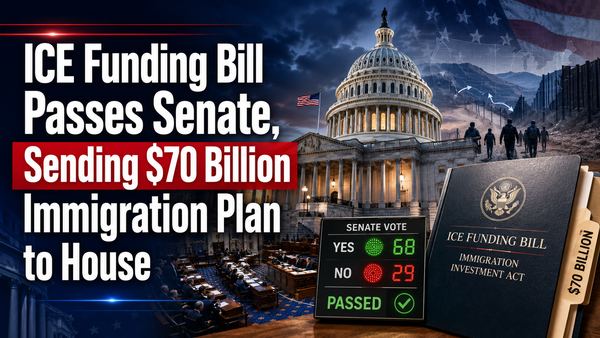
The Senate passed the ICE funding bill early Friday, voting 52-47 to advance roughly $70 billion for ICE, Border Patrol and related immigration enforcement operations. The measure is not law yet; it now moves to the House, where the Associated Press reported lawmakers are expected to take it up next week.
Yes. The official Senate roll call shows S. 2, as amended, passed on a 52-47 vote, with one senator not voting.
The bill was considered under the title “An original bill to provide for reconciliation pursuant to title II of S. Con. Res. 33.” The Senate page listed the vote as passage of the bill, meaning the chamber approved the measure and sent it to the next step in the legislative process.
The vote was largely along party lines. The Senate roll call showed Sen. Lisa Murkowski of Alaska as the only Republican voting no. Sen. Michael Bennet of Colorado was listed as not voting.
The package is aimed at immigration enforcement and border operations over the remaining years of President Donald Trump’s term. The Congressional Budget Office estimated the committee package that produced S. 2 at $71.652 billion in budget authority over the 2026-2035 period, with funds generally available for obligation through fiscal year 2029.
The largest pieces include money for ICE, Customs and Border Protection, the Department of Homeland Security, the Department of Justice and the Secret Service.
ICE: CBO listed $7.45 billion for Homeland Security Investigations personnel, operations and mission support, plus $30.725 billion for ICE activities such as hiring and equipping personnel, transportation tied to apprehension and removal, facilities, technology and coordination with state and local governments.
Customs and Border Protection: CBO listed about $22.6 billion for CBP personnel and border technology under the Homeland Security and Governmental Affairs portion, plus $3.47 billion for CBP personnel, operations and support under the Judiciary portion.
Other accounts: CBO also listed $5 billion across additional DHS accounts, $1.457 billion for DOJ activities and $1 billion for Secret Service security upgrades.
The Senate debate was also shaped by a separate dispute over an approximately $1.8 billion settlement fund tied to claims of government “weaponization.” The Associated Press and Reuters reported that critics in both parties pushed to permanently block or redirect that money before final passage.
Those efforts did not succeed. Senate roll calls show multiple amendments and motions related to the issue failed before the final vote.
Republican leaders cited Justice Department assurances that the fund would not move forward. Democrats and some Republican critics argued that an agency assurance was not enough and wanted a statutory prohibition written into the bill.
The House must pass the same bill before it can become law. If the House approves the Senate-passed text without changes, the measure can go to the president. If the House changes the bill, the Senate would have to act again or the two chambers would need to resolve the differences.
The House Clerk listed the chamber as not in session at the time of the latest check, with the next session scheduled for June 8. No final House vote time on S. 2 had been officially posted in the accessible House schedule reviewed.
The next public signs of movement are likely to come from the House floor schedule, the Rules Committee or a posted vote notice.
The most important question is whether House Republicans have the votes to pass the Senate version. A clean House vote would move the bill to Trump’s desk faster. Any changes would slow the process because the Senate would need another chance to approve the final text.
Readers tracking the bill should watch for three things: a House rule for floor debate, any changes to the Senate-passed text and the final House roll call. Until the House passes the bill and the president signs it, the new funding is not in effect.