 orywire
News that matters globallyReporting on public life and major developments across the U.S., the UK, and beyond.
orywireThe Senate passed a roughly $70 billion ICE and Border Patrol funding bill after failed votes to limit a Trump-linked settlement fund. The measure now moves to the House, so it is not yet law.
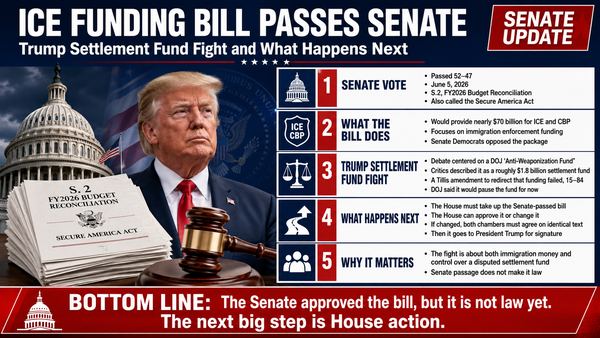
The Senate passed the ICE funding bill early Friday, approving roughly $70 billion for immigration enforcement after a long fight over a Trump-linked settlement fund. The bill now goes to the House, which means the money is not final until the House acts and President Donald Trump signs it.
The measure is aimed mainly at ICE, short for Immigration and Customs Enforcement, and Border Patrol operations. The Senate’s public roll-call list showed S. 2 passed June 5 by a 52-47 vote.
The bill would provide immigration enforcement money for the next three years, covering the rest of Trump’s term. AP and Reuters described the package as roughly $70 billion for ICE, Border Patrol and related Department of Homeland Security work.
The Congressional Budget Office previously estimated the Senate committee recommendations at about $71.7 billion in budget authority. That estimate said the legislation would directly appropriate money for Customs and Border Protection, ICE, the Department of Homeland Security and the Justice Department.
The earlier CBO estimate described funding for hiring, pay, training, equipment, technology, border security and immigration enforcement activities. It also included Justice Department money for investigations, prosecutions and immigration law enforcement.
The exact final line items should be checked again if the House passes the bill, because floor changes and House action can affect the text that ultimately goes to the president.
The funding fight has been tied to broader disagreements over immigration enforcement. Democrats had sought policy conditions on federal immigration authorities, while Republicans argued that ICE and Border Patrol should be funded without those conditions.
Republicans used budget reconciliation, a process that allows certain budget bills to pass the Senate with a simple majority instead of the 60 votes usually needed to overcome a filibuster. That allowed the bill to pass without Democratic support.
The Senate debate was then slowed by disputes within the Republican conference over issues outside the core ICE and Border Patrol funding. The most important was the Justice Department’s $1.776 billion Anti-Weaponization Fund, which became a major point of concern for Democrats and some Republicans.
The Justice Department announced the Anti-Weaponization Fund in May as part of a settlement agreement in President Donald J. Trump v. Internal Revenue Service. The department said the fund would receive $1.776 billion from the federal judgment fund, an account used to pay certain settlements and judgments.
DOJ said the fund was intended to provide a process for people who said they suffered “weaponization and lawfare.” The department also said Trump, Donald Trump Jr., Eric Trump and the Trump Organization would receive a formal apology but no monetary damages as part of the settlement.
The announcement quickly became politically explosive. Critics said the fund could become a taxpayer-funded way to compensate Trump allies, including people connected to Jan. 6 cases. Supporters framed it as a remedy for people who believed they had been unfairly targeted by the government.
Acting Attorney General Todd Blanche later told lawmakers that the Justice Department was not moving forward with the fund. But several senators said they wanted a legislative ban rather than relying on the department’s statement.
No. The Senate passed the ICE funding bill without adding a permanent ban on the settlement fund.
Senators rejected multiple attempts to restrict, redirect or bar payments connected to the fund. The public Senate vote list showed failed votes on amendments and motions involving payments to certain individuals, compensation for law enforcement officers injured at the Capitol on Jan. 6, and efforts to reallocate money to fraud enforcement.
That leaves the issue in an unsettled position. Blanche’s testimony said DOJ would not proceed with the fund, but the Senate-passed bill does not itself shut it down. Reuters reported that the House is expected to take up the measure next week, and any House changes could send the bill back into negotiation.
The House has three basic options.
It can pass the Senate bill without changes. If that happens, the measure would go to Trump for his signature.
It can amend the bill. If the House changes the text, the Senate would need to agree to the same version before the measure could become law.
Or the House can delay action, which would keep the funding fight unresolved.
The next House step matters because the bill is not yet law. For readers searching for the status of the ICE funding bill, the main point is that the Senate has acted, but the House has not completed the process.
The first thing to watch is whether House Republican leaders bring up S. 2 next week and whether they keep the Senate version intact. Changes to the bill could reopen questions over timing, amendments and final passage.
The second issue is the settlement fund. A written Justice Department rescission, a court ruling or new House language could change the status of the Anti-Weaponization Fund. Without that, the latest verified status is that DOJ says it is not moving forward, but Congress has not enacted a ban through the Senate-passed bill.
The third issue is the final text. The funding numbers most readers see are rounded to about $70 billion, but the precise allocations will depend on the version that passes both chambers.
This article should be updated after House scheduling action, any new Justice Department filing on the settlement fund, or a final House vote.