 orywire
News that matters globallyReporting on public life and major developments across the U.S., the UK, and beyond.
orywireCDC says multistate Salmonella outbreaks linked to backyard poultry remain open, with 513 reported illnesses, 134 hospitalizations and one death. Families and flock owners are urged to wash hands, keep birds outside the home and keep young children away from chicks and ducklings.

The Salmonella outbreaks linked to backyard poultry are still active, according to the CDC. The agency lists the investigation as open and says families with backyard flocks should wash hands after contact with birds, keep poultry out of the house and keep children younger than 5 away from chicks and ducklings.
CDC’s latest investigation update, dated June 17, reported 513 illnesses linked to eight multistate Salmonella outbreaks tied to backyard poultry. The agency reported 134 hospitalizations and one death in Washington.
The outbreak page lists cases in 42 states and a U.S. territory. CDC’s detailed update says illnesses began from January 20 through May 22, and the case count was current as of June 8.
The reported number is likely an undercount. CDC says many people recover without medical care or testing, and it can take three to four weeks to determine whether a recent illness is part of an outbreak.
Backyard poultry can carry Salmonella germs even when birds look healthy and clean, CDC says. The germs can spread to coops, cages, feed and water containers, eggs, shoes and other items in areas where birds live or roam.
People can get sick after touching poultry or contaminated items and then touching food or their mouth. In interviews, 306 of 391 sick people reported contact with backyard poultry.
CDC says backyard poultry includes birds such as chickens, ducks, geese, guinea fowl and turkeys. The largest outbreak in the current investigation has involved an unusually high number of people reporting contact with ducks, especially Pekin ducks.
The outbreak strains include Salmonella Enteritidis, Indiana, Infantis, Mbandaka and Saintpaul. CDC says epidemiologic, traceback and laboratory data show that contact with backyard poultry is making people sick.
Among people who reported owning backyard poultry, 165 of 196 said they had purchased or obtained poultry since January 1. Most reported buying birds from agricultural retail stores.
CDC says the outbreak strains have been linked to seven hatcheries, and investigators are still reviewing where sick people obtained poultry and which hatcheries supplied the stores involved. Additional hatcheries may be linked as the investigation continues.
Laboratory analysis also predicts that some strains in the outbreaks are resistant or not susceptible to antibiotics commonly recommended for severe Salmonella infections. CDC says most people recover without antibiotics, but severe or complicated illness should be evaluated by a health care provider.
Most people infected with Salmonella develop diarrhea, fever and stomach cramps. Symptoms usually begin six hours to six days after swallowing the bacteria, and most people recover in four to seven days without treatment.
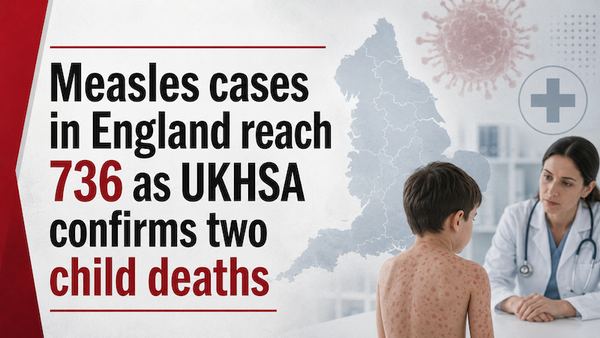
UKHSA says England has recorded 736 laboratory-confirmed measles cases so far in 2026, with two child deaths confirmed. The latest figures show recent activity has been highest in London, the East of England and the West Midlands.
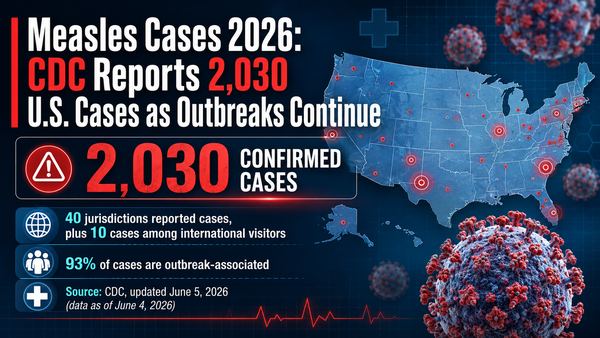
The CDC says 2,030 confirmed measles cases have been reported in the United States in 2026, with most cases tied to outbreaks. The latest update also explains why state counts may differ from the national total.
Some people are more likely to develop severe illness. CDC identifies children younger than 5, adults 65 and older, and people with weakened immune systems as higher-risk groups.
CDC says people should call a health care provider right away for these symptoms:
Diarrhea and a fever higher than 102 degrees.
Diarrhea lasting more than two days without improvement.
Bloody diarrhea.
Vomiting that prevents keeping liquids down.
Signs of dehydration, including little urination, dry mouth or throat, or dizziness when standing.
CDC says the safest approach is to treat all backyard poultry and their environment as possible sources of Salmonella, even if the birds appear healthy.
Wash hands with soap and water immediately after touching backyard poultry, their eggs or anything in areas where the birds live and roam. Use hand sanitizer if soap and water are not available.
Do not kiss or snuggle backyard poultry, and do not eat or drink around them.
Keep poultry and supplies outside the home. Feed containers, coop shoes and cleaning equipment should stay outdoors and be cleaned outdoors.
Supervise children around flocks. Children younger than 5 should not handle chicks, ducklings or other backyard poultry, or spend time in areas where the birds live and roam.
Handle eggs safely. Collect eggs often, throw away cracked eggs, refrigerate eggs and cook eggs until both the yolk and white are firm. CDC says egg dishes should reach 160 degrees.
The CDC investigation remains open, so the case count, affected jurisdictions, hatchery links and laboratory findings may change with future updates.
Families with backyard flocks should keep following CDC prevention steps even outside an outbreak. The agency says Salmonella outbreaks linked to backyard poultry are common, and healthy-looking birds can still carry germs that make people sick.
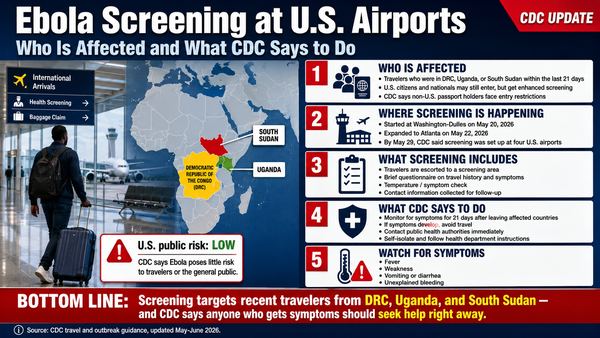
CDC says certain travelers who were recently in the Democratic Republic of the Congo, Uganda or South Sudan may be routed to four U.S. airports for enhanced Ebola screening. The agency says the U.S. risk remains low, but affected travelers should monitor symptoms for 21 days after leaving those countries.