 orywire
News that matters globallyReporting on public life and major developments across the U.S., the UK, and beyond.
orywireThe Supreme Court denied Alabama’s emergency request to use nitrogen hypoxia to execute Jeffery Lee, leaving a lower-court injunction in place. The order stopped the execution for now but left several legal questions unresolved.
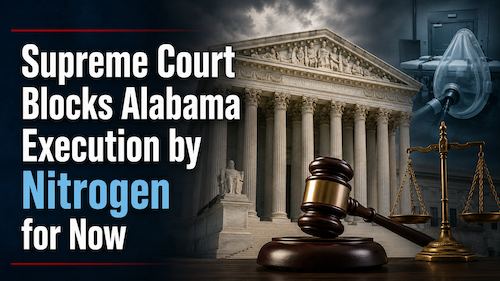
The Supreme Court blocked Alabama from carrying out Jeffery Lee’s nitrogen hypoxia execution for now, and the execution did not happen during the scheduled window. The justices denied Alabama’s emergency request to lift a lower-court injunction that bars the state from using its nitrogen protocol on Lee.
The court’s order was brief. The Supreme Court docket says Alabama’s application for a stay or vacatur was presented to Justice Clarence Thomas, referred to the full court and denied.
The order noted that Justices Thomas, Samuel Alito and Neil Gorsuch would have granted Alabama’s request. The court did not publish a full opinion explaining its reasoning, and it did not issue a final ruling on the broader constitutionality of nitrogen hypoxia executions.
The immediate effect was to leave the lower-court injunction in place.
The lower-court dispute centered on Alabama’s nitrogen hypoxia protocol, which uses nitrogen gas to replace breathable air. Lee argued that the protocol would violate the Eighth Amendment, which bars cruel and unusual punishment.
After earlier rulings moved back and forth, the 11th U.S. Circuit Court of Appeals concluded that Alabama’s nitrogen protocol posed a substantial risk of serious harm. On remand, U.S. District Judge Emily C. Marks found that Lee had shown a firing squad would be a feasible alternative that would significantly reduce that risk.
Marks then permanently barred Alabama from executing Lee under the nitrogen protocol. Her order did not overturn Lee’s death sentence or block Alabama from carrying out capital punishment by every possible method. The ruling was limited to nitrogen hypoxia as applied to Lee.
No. Lee’s execution did not go forward.
Court filings said he had been scheduled to die by nitrogen hypoxia on Thursday, June 11. AP reported that a spokesperson for the Alabama Department of Corrections said the execution was off for the evening and that the state would not try another method that night.
As of Friday morning, no new execution date had been announced. ABC 33/40 reported that no additional information was immediately available about when Alabama might seek another execution date.
The Supreme Court’s order does not end the case. It denies emergency relief to Alabama, but it does not settle all appeals or determine whether Alabama’s nitrogen protocol is unconstitutional in every future case.
Alabama may continue litigating the lower-court injunction. State officials also may decide whether to seek a new execution date or pursue another legally available path. The Alabama Attorney General’s Office said after the ruling that the state remains prepared to seek to carry out Lee’s sentence.
The lower courts also did not order Alabama to use a firing squad. That evidence mattered because, in this type of method-of-execution challenge, courts compare the challenged method with an available alternative. The ruling leaves open what Alabama will argue next and what any later execution request would look like.
Lee was convicted in 2000 of capital murder and attempted murder after the 1998 killings of Jimmy Ellis and Elaine Thompson during an attempted robbery at a pawn shop. Court records say the jury recommended life imprisonment without parole by a 7-5 vote, but the trial judge overrode that recommendation and sentenced him to death.
Alabama later ended judicial overrides in capital cases. The district court noted that the change does not apply retroactively to defendants who had already been sentenced to death before April 11, 2017.
The next meaningful updates would be a new ruling in the 11th Circuit appeal, a new Supreme Court filing, a revised state execution request or a new execution date. Until then, the clearest answer is that the Supreme Court stopped Alabama from using nitrogen hypoxia on Lee for now, but it did not resolve the entire death-penalty case.