 orywire
News that matters globallyReporting on public life and major developments across the U.S., the UK, and beyond.
orywireIran’s military said the Strait of Hormuz was being closed over alleged ceasefire violations, but U.S. officials said they had not seen evidence of a full shutdown. The waterway remains central to oil, LNG and global shipping, making the claim important even if traffic has not stopped.
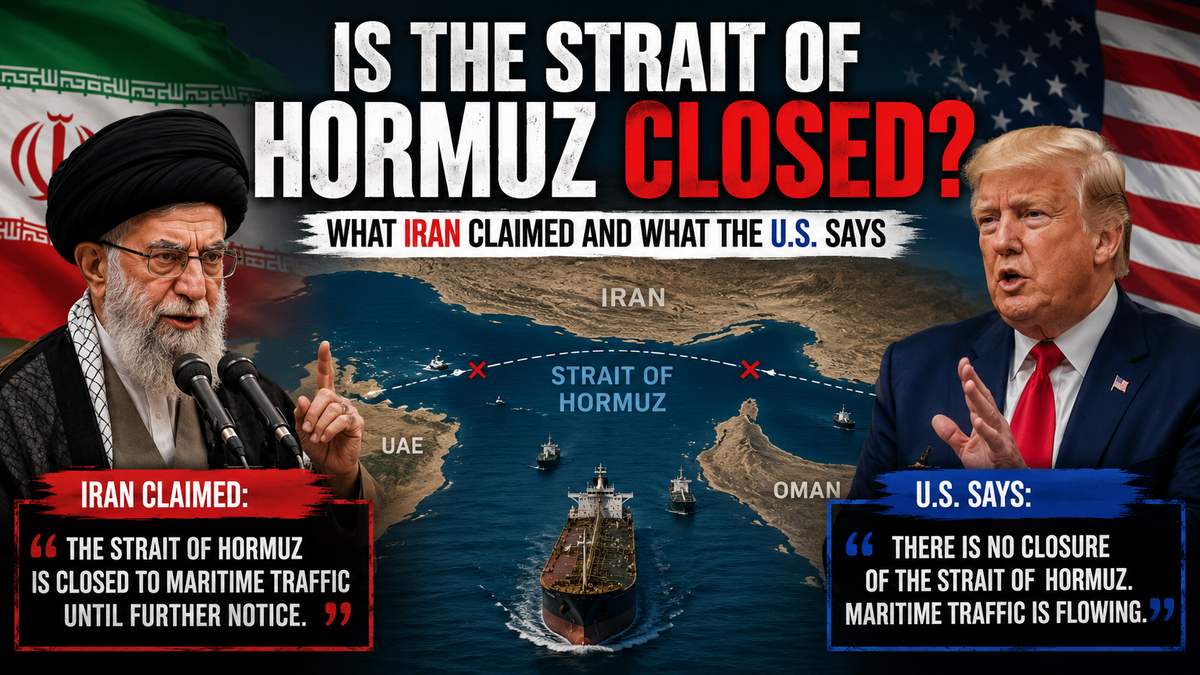
Claims that Iran has closed the Strait of Hormuz should be treated with caution. Iran’s joint military command and the Islamic Revolutionary Guard Corps, or IRGC, said Saturday the waterway was being closed over alleged U.S. and Israeli ceasefire violations, while U.S. officials and maritime guidance checked Saturday did not verify a full halt to traffic.
Vessel operators still face a serious security situation. The latest Joint Maritime Information Center advisory available at the last check listed the strait as open but warned of mines, congestion and continuing naval clearance operations.
Reuters reported that Iran’s Khatam al-Anbiya Central Headquarters, described as the country’s top joint military command, said the Strait of Hormuz would be closed to vessel traffic. The command cited alleged violations of a ceasefire agreement by the U.S. and Israel, according to Iran’s Mehr state news agency.
Reuters also reported that the IRGC declared the strait shut and warned ships not to approach the waterway. The warning came as new fighting in Lebanon raised doubts about the regional ceasefire arrangements connected to U.S.-Iran talks.
The announcement matters because Iran’s military forces are positioned along the northern side of the strait. But an announced closure is not the same as a confirmed stop in all vessel traffic, especially in a narrow waterway where shipping decisions depend on naval guidance, mine risk, insurance coverage and real-time vessel tracking.
U.S. Vice President JD Vance said in a Fox News interview that he had seen no evidence that the strait was closed, Reuters reported. The Associated Press separately reported that the U.S. military said commercial ship traffic continued through the strait Saturday, including 55 merchant ships moving cargo and more than 17 million barrels of oil, while noting it was not clear when in the day those ships had transited.
The latest public advisory from the Joint Maritime Information Center, dated Saturday, was titled “Strait of Hormuz Open.” It said the regional maritime security threat level remained moderate and advised that mariners could transit a southern route day or night with standard navigation systems operating.
That same advisory did not describe the route as risk-free. It warned mariners to expect mines, naval presence, congestion through transit routes and possible radio contact from naval forces.
Taken together, the checked sources support a narrower statement: Iran announced a closure, but a full stop in shipping had not been publicly established in those reports.
The Strait of Hormuz sits between Iran and Oman and connects the Persian Gulf with the Gulf of Oman and the Arabian Sea. The U.S. Energy Information Administration describes it as one of the world’s most important oil chokepoints.
In 2024, oil flows through the strait averaged about 20 million barrels per day, equal to about 20% of global petroleum liquids consumption, according to the EIA. The agency also said about one-fifth of global liquefied natural gas trade moved through the strait in 2024, mainly from Qatar.
The route is especially important for Asian energy buyers. The EIA estimated that 84% of crude oil and condensate and 83% of liquefied natural gas that moved through the strait in 2024 went to Asian markets.
A credible threat to the Strait of Hormuz can affect more than tankers already at sea. It can influence crude prices, shipping insurance, vessel routing, refinery planning and LNG supply expectations.
The EIA has warned that when oil cannot transit a major chokepoint, even temporarily, the disruption can create supply delays, raise shipping costs and potentially increase world energy prices. Some routes can be bypassed, but Hormuz is unusually hard to replace.
Saudi Arabia and the United Arab Emirates have pipelines that can avoid the strait, but the EIA estimated that about 2.6 million barrels per day of available pipeline capacity could be used to bypass Hormuz during a disruption. That is only a fraction of the normal oil flow through the waterway.
The immediate question is whether Iran will try to enforce the announcement and whether shipowners, insurers and naval authorities will treat the strait as practically closed, partially restricted or open with elevated risk.
Another key issue is timing. AP reported that U.S. officials said traffic continued Saturday but also noted that it was not clear when the ships passed through. That matters because a closure claim can come after earlier traffic has already cleared the route.
Mine risk remains a separate problem. JMIC’s advisory said naval clearance operations were continuing and told vessels to seek safe-route information from maritime coordination authorities.
The most useful next updates will come from maritime advisories, U.S. military statements, Iranian official statements and trusted wire-service reporting from the region.
For mariners, the practical question is not only whether Iran says the strait is closed. It is whether the recommended transit route remains open, whether mines or military activity change the risk level, and whether naval authorities issue new instructions.
For energy readers, the key indicators are confirmed vessel traffic, crude and LNG flow data, insurance restrictions and any change in U.S.-Iran talks that affects the ceasefire framework.