 orywire
News that matters globallyReporting on public life and major developments across the U.S., the UK, and beyond.
orywireJaneese Lewis George won the Democratic primary for D.C. mayor after Kenyan McDuffie conceded. Results remain unofficial pending D.C. Board of Elections certification.

Janeese Lewis George has won the Democratic primary for D.C. mayor, according to the Associated Press, after Kenyan McDuffie conceded Thursday. The result is not yet certified by the D.C. Board of Elections, so vote totals can still change as the board finishes its canvass.
At the race call, 7News reported the AP count showed Lewis George with 55,214 votes, or 52.9%, and McDuffie with 38,033 votes, or 36.4%, with about 75% of expected ballots counted. Other candidates were far behind the two front-runners.
Lewis George’s share put her above the 50% first-choice threshold in D.C.’s ranked-choice system. That margin was central to the AP call, but election officials still must complete the official count and certification.
McDuffie, a former D.C. Council member, conceded Thursday morning and said he had called Lewis George to congratulate her. In his statement, he said final certification would continue but that voters had chosen a different path.
Lewis George, a Ward 4 D.C. Council member, described herself as the presumptive Democratic nominee at a Thursday news conference. WTOP reported Friday that she said early conversations had started around transition planning, including budget and policy priorities, while she continues serving Ward 4.
The D.C. Board of Elections, not the AP, certifies the final result. The board’s primary election calendar lists several post-election steps that can affect final totals, including mailed ballots, special ballots and challenged ballots.
The calendar says mailed ballots must be received by Friday, June 26, if they were postmarked on or before Election Day. It also lists a Tuesday, July 7, tentative final count for mail ballots and accepted special and challenged ballots.
The tentative certification date is Friday, July 17. A certification date on the board’s calendar is not the same as a certified result; it is the target date for the official action.
This was D.C.’s first election using ranked-choice voting, AP reported. Under ranked choice, voters can rank candidates, and additional rounds may be used if no candidate receives a majority of first-choice votes.
Because Lewis George was above 50% in the unofficial first-choice count reviewed after the primary, the race did not hinge on lower-ranked choices at the time AP made its call. That could become relevant only if later official counting changed the first-choice picture enough to require additional ranked-choice rounds.
Lewis George advances toward the Nov. 3 general election for a race to replace Mayor Muriel Bowser, who did not seek another term after three terms in office. In heavily Democratic D.C., the Democratic nominee is typically strongly positioned in the general election, but the mayoral race is not final until voters cast ballots in November and the general election is certified.
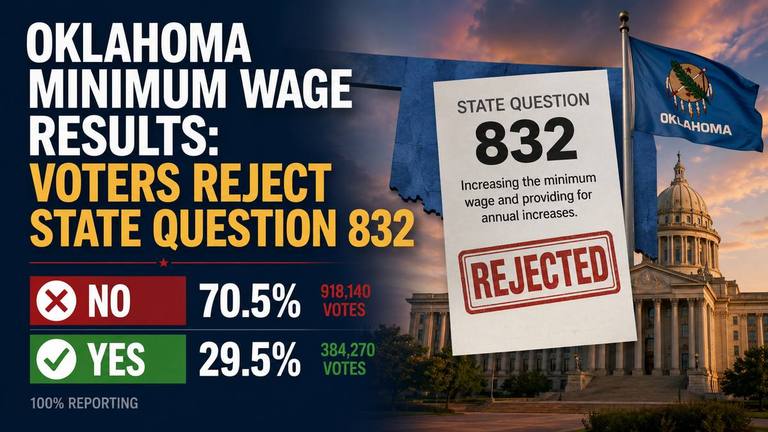
Oklahoma voters rejected State Question 832, the ballot measure that would have raised the state minimum wage to $15 an hour by 2029. The vote means Oklahoma’s minimum wage remains unchanged unless lawmakers or voters approve a future increase.

Mike Collins won Georgia’s Republican U.S. Senate runoff, and Rick Jackson won the Republican runoff for governor, according to AP race calls and unofficial state returns. The results set up November matchups against Sen. Jon Ossoff and Keisha Lance Bottoms.
For readers following the result, the next key checkpoints are the June 26 mailed-ballot deadline, the July 7 tentative final count and the July 17 tentative certification date. Official updates should come from the D.C. Board of Elections results portal and public notices.
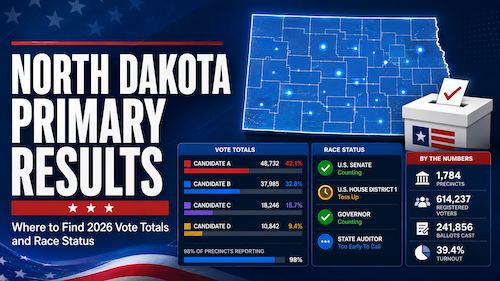
North Dakota’s June 9 primary returns are available through the Secretary of State’s election results site. Results remain unofficial until county and state canvassing boards complete certification.